
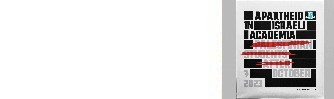



New Report by Adalah: “Apartheid in Israeli Academia: Palestinian Students After 7 October 2023”
Adalah – The Legal Center for Arab Minority Rights in Israel publishes a new report today examining the discriminatory disciplinary policies pursued since 7 October 2023 by Israeli universities and colleges toward Palestinian students, predominantly citizens of Israel. Based on an analysis of the dozens of disciplinary proceedings opened against Palestinian students at around 40 academic institutions in response to the students’ social media posts, the report finds that Israeli academia has created a two-track disciplinary system, amounting to apartheid within higher education between Jewish-Israeli and Palestinian students.
The report was co-authored by Adalah Attorneys Lubna Tuma, Adi Mansour, and Attorney Mai Diab, and edited by Dr. Fady Khoury.
Israeli academic institutions began suspending Palestinian students in the days immediately following 7 October, opening disciplinary proceedings against them, and classifying their posts as “support for terror.” These actions occurred amid political pressure from state officials, including the Minister of Education, to suspend students and conduct expedited disciplinary proceedings against them. In some cases, academic institutions even reported their own students to the police, leading to arrests.
The consequences of this institutional policy were severe: Adalah received 132 inquiries from students at close to 40 academic institutions, most of which (76.5%) came from female students. Adalah legally represented or offered legal counsel to 100 students. In more than 80 cases, academic institutions imposed an interim suspension before any hearing took place, and in 20 cases permanently expelled students or suspended them for one-to-five years. In a number of cases, Adalah’s appeals led to the reversal of convictions or a significant reduction of penalties.
According to the report, a wide range of expressions triggered disciplinary proceedings, including criticism of Israeli government policy, the Israeli military, or the war in Gaza; content related to the 7 October attacks; the dire humanitarian situation in the Gaza Strip; religious expressions including verses from the Qur’an; and visual symbols of Palestinian identity. In some cases, a mere “like” of a post, the display of a Palestinian flag or the word “Palestine” on a profile, sharing a news report, or posting a prayer for the residents of Gaza was enough to trigger a complaint or disciplinary proceeding.
The report points to structural, recurring flaws in the manner in which academic institutions handled these proceedings, finding that the burden of proof shifted: instead of institutions having to prove that an offense had occurred, students had to prove that their posts did not amount to support for terror. Institutions also expanded their disciplinary authority into private posts unrelated to academic studies almost exclusively by Palestinian students, while refraining from doing so for Jewish-Israeli students, even in cases involving extreme, inciting, and racist speech.
As a result, the report argues, Israeli academia has been transformed from a body regulating students’ conduct in connection with their studies into a body policing private expression of their students and determining which expressions of Palestinian identity, religion, solidarity, and criticism are legitimate.
The report concludes that, after October 2023, Israeli academic institutions established two distinct tracks of disciplinary law de facto: an administrative track and a constitutional track. For Palestinian students, the institutions established an emergency “administrative track”, characterized by the expansion of academic institutions’ authority, the curtailment of procedural protections, the use of vague tests, and the examination of statements within a securitized discourse predicated on concepts of loyalty and “enemy”. Alongside this track, the institutions applied a “constitutional track” for Jewish-Israeli students, in which the boundaries of authority and freedom of expression were largely preserved, even in relation to extreme expression. Notably, Israeli academic institutions ignored students’ widespread calls for the annihilation and genocide of the Palestinian people in Gaza and racist posts directed against Palestinian citizens of Israel in general, and their fellow Palestinian students in particular.
The report warns that this policy creates a “chilling effect” among Palestinian students, encourages self-censorship, and undermines their sense of security and belonging on campus.
To watch an explanatory video about the report
To view an infographic by Visualizing Palestine which visualizes the findings of the report.